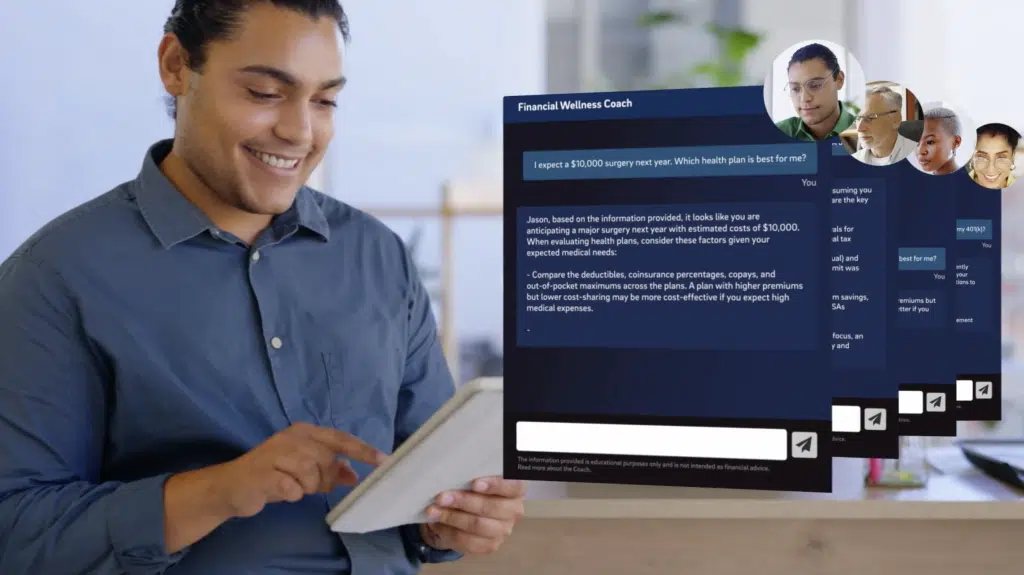
Every benefits category is being asked the same question right now: where does AI fit? In financial wellness, the wrong answer is easy to spot. Bolt a generic chatbot onto an existing content library, point it at the open internet, and call it AI-powered guidance. The right answer is harder and more deliberate: build financial wellness AI that extends what a certified advisor and a well-designed platform already do well, without replacing either one.
Why “just add a chatbot” doesn’t work for financial wellness: closed AI vs. an open AI model
Financial guidance is a category in which a generic, open-ended AI model is NOT a safe default. Anyone operating in the financial space needs airtight protocols around AI technology deployment and AI governance policies. An employee who uses an AI-based tool for financial guidance will share account balances, debt information, and personal financial goals. They need a system trained specifically to act in their interest, a fiduciary standard rather than a general-purpose one. They don’t need a model pulling from anything on the open internet that could produce a seemingly confident but horrifically incorrect answer.
A closed, purpose-built financial wellness AI is trained on proprietary, vetted content created for that purpose, so the guidance it gives stays grounded in what’s actually true for that employee, not a plausible-sounding guess.
A responsible design also means being transparent that the employee is talking to AI in the first place. That’s a deliberate choice, not a limitation: employees are often more comfortable sharing sensitive financial details with a non-judgmental AI than with a human they fear might judge them, but that comfort only holds if the interaction is honest about what it is.
The difference comes down to a closed AI model versus an open one. An open AI model like ChatGPT draws on the entire open internet to answer any question, with no guardrails tying its answers to a specific employee’s actual finances. A closed AI model built for financial wellness is trained only on vetted, proprietary content and connected to the individual’s own linked accounts and goals, so it never has to guess: it works from what’s actually true for that person.
Complementing human advisors, not replacing them
The more important design decision is what happens at the boundary between AI and a human advisor. Most models are now trying to push an AI-only model, but BrightPlan understands the value of having both AI and human expertise combined. In many basic hybrid models currently on the market, the two channels often run in parallel: an employee can use a basic chatbot, or they can book time with a real human financial advisor, but chatbots alone are error-prone and lack meaningful oversight necessary for important financial tasks. Compounding the problem, the two experiences often don’t talk to each other. That’s a missed opportunity in supporting financial success for individuals. And the more complex a person’s financial situations are, the greater the gap.
A better model treats AI and human advisors as sequential layers of one experience rather than separate pathways. When an employee schedules time with a certified financial planner (CFP), the advisor should enter that conversation already able to see the employee’s linked accounts, active goals, and prior AI coaching topics. The advisor isn’t spending the first part of the session gathering basic information; they’re providing expert judgment from the first moment, on the specific situation the employee is actually facing.
Employees are looking for answers to money issues, which can be highly stressful. They want help – much like with a medical issue – so they expect swift and personal attention to their issue. Keep in mind, the advisor’s pay model matters as much as the credential. Here’s why: an advisor paid on salary rather than commission, selling no products, has zero incentive to steer an employee anywhere except toward the optimal decision for each employee.
This changes what AI is actually for. The trap is treating it as a way to answer every question more efficiently, or as a ‘good enough’ substitute for human-to-human guidance. Deployed properly, AI can help expand the reach of guidance for everyday questions and straightforward decisions, so that qualified human advisors can spend their time where it matters most: focusing on complex financial situations, major life events, and the emotional dimensions of financial stress that no AI model can fully address on its own. The goal is to have a higher volume of impactful, customer-focused advisor conversations, versus a way to improve efficiency through AI.
Complementing the technology employees and employers already rely on
The responsible use of AI for finances also means fitting into the financial picture an employee already has, rather than asking them to start over inside a new tool. When an employee links accounts, sets goals, and already has incorporated employer benefits information, the AI can surface things that would otherwise stay buried: an underutilized 401(k) match, an HSA contribution opportunity, an ESPP enrollment window, or a suggestion to reconsider a high-interest balance. These are examples of critical benefit utilization gaps that otherwise go unnoticed. It works by connecting to what’s already there, not by asking the employee to re-enter their financial life into yet another system.
That same logic applies to security and oversight. AI in financial wellness should sit inside a framework that includes CFP-level professional standards for any human guidance layered on top in addition to a defined fiduciary responsibility, and Registered Investment Adviser (RIA) status. Let’s not forget independent information-security certifications such as SOC 2 Type 2, ISO 27001, and GDPR compliance, which govern how sensitive financial data is handled. AI capability without that framework isn’t a shortcut; it’s a liability.
What employers gain from financial wellness AI: anonymized workforce analytics
The benefits of a well executed AI layer aren’t limited to the employee experience. Done well, it gives employers a kind of visibility they don’t otherwise have, without ever exposing an individual employee’s private financial details.
Anonymized, aggregated analytics can surface financial risk patterns across a workforce before they show up as a harder problem to solve. Rising debt-stress indicators in a specific population can predict an increase in 401(k) loan applications or medical benefit utilization before either one happens. A segment of employees underusing a particular benefit can point to a navigation gap or a communication gap rather than a lack of need. Employers can even track how program participation moves the needle on workforce financial health over time, evidence that’s hard to come by any other way.
This is what turns financial wellness from a line-item benefit into a strategic HR input: population-level intelligence that can inform total rewards effectiveness and design, sharpen internal communication, and give HR and benefits leaders a data-backed answer and business case when a CFO or board asks for proof the investment is working. That answer connects directly to the goals benefits leaders are already accountable for. Financial stress is a documented drag on productivity, showing up as distraction, absenteeism, and presenteeism, so early, anonymized visibility into rising financial stress is also visibility into a productivity risk before it fully materializes. The same engagement data that shows a program is working doubles as evidence for the retention case: employees who actively engage with financial wellness support consistently show stronger retention than those who don’t, in a benefit that’s inexpensive to offer relative to the cost of replacing an employee. None of it requires seeing an individual employee’s data. The employer sees patterns tied to productivity, engagement, and retention; the employee keeps their privacy.
What this means for evaluating a financial wellness AI provider
The practical test for any employer evaluating a financial wellness AI technology, the heart of any financial wellness vendor review, is simple: does it make the human advisors better, or does it exist instead of them? A closed model trained on vetted, proprietary content is a strong start. Add transparency about what it is and a real connection to the employee’s actual financial picture, and it’s most of the way there. Give it a clean handoff to a certified professional when a problem is complex enough to need human judgment, and it’s doing what AI in this category should do.
That’s the standard worth holding it to: not how much it can do on its own, but how much better it makes everything around it. The advisor conversation starts already informed. The benefit an employee was about to miss. The guidance that’s there at 11 p.m. when no advisor is on the line. Built that way, AI earns its place in financial wellness, not by replacing the people and platforms already doing this work, but by making them better.