BrightPlan Bellwether Report
State of Financial Wellness: 2026 Industry Report by Brandon Hall Group
Explore resultsFinancial wellness is an employee's ability to manage financial stress in the near term, not just save for retirement decades away. Yet most employers are still addressing it the way they did a decade ago: generic content and calculators. Employee expectations have moved past that.
Brandon Hall Group, the Workforce Excellence Intelligence company, examines that gap in its 2026 report on the state of financial wellness. The report lays out a four-stage Financial Wellness Maturity Framework, the real cost of leaving financial stress unaddressed, including an average $103,000 per employee who delays retirement, and the five characteristics that separate financial wellness solutions that change behavior from financial wellness benefits that just report participation.
It also examines BrightPlan's financial wellness platform, data-connected AI coaching, unlimited CFP®-certified financial planner access, and structured behavioral programs, and why Brandon Hall Group's research names BrightPlan a leader in financial wellness. That model is behind a 79% financial resiliency rate among participants in BrightPlan's Resolution Program, across more than 10 million employees in 50+ countries.
Explore the full report below for the framework, the data, and what a financial wellness solution built for outcomes actually looks like.
About The Report


Employers are stuck in the wrong time horizon
Most benefits strategies focus on long-term retirement vehicles while ignoring the short- and medium-term needs — emergency savings, debt, life events — where the majority of employee financial stress actually lives.

Unaddressed financial stress carries a real cost
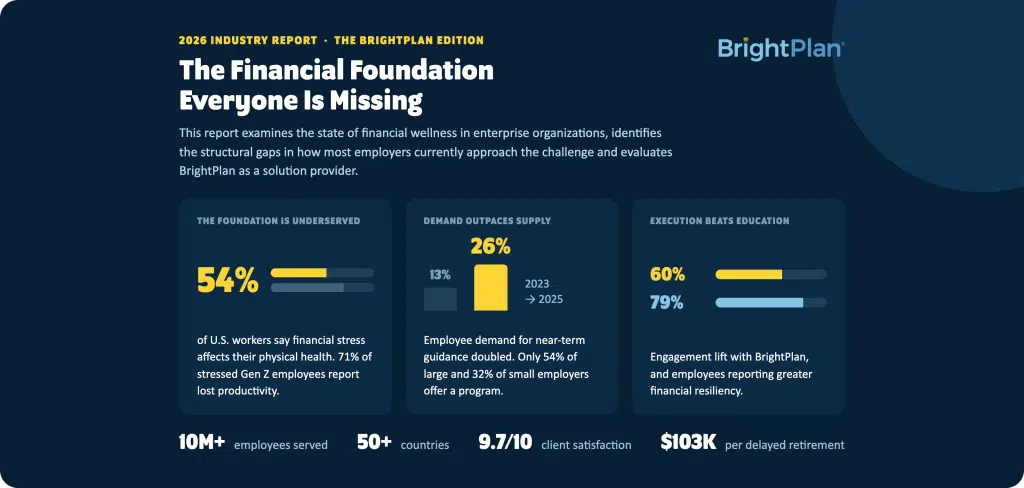
Delayed retirements cost employers an average of ~$103,000/year per employee who stays past 65. Only 18% of HSA holders invest any funds beyond cash. 71% of financially stressed Gen Z employees report reduced productivity, and 54% of U.S. workers say financial stress affects their physical health.

The market is moving from education to execution
Employers no longer want content libraries and webinars — they want evidence of behavior change: higher savings rates, reduced debt, on-time retirement, and measurably lower financial stress.

AI and human advisors work best together, not as parallel tracks
The most effective model uses AI to extend personalized, data-connected guidance at scale, while certified human advisors (CFP®s) handle the complex, emotional, high-stakes decisions — entering each conversation already informed rather than starting cold.

60% engagement lift, 79% report greater resiliency, 10M+ employees served
BrightPlan's model — AI coaching + unlimited CFP® access + structured behavioral programs + employer analytics — delivers a ~9.7/10 global client satisfaction score across 50+ countries.

Demand is outpacing supply
Employee demand for near-term financial guidance from employers doubled from 13% (2023) to 26% (2025) — Bank of America. Yet only 54% of large employers and 32% of small employers currently offer financial wellness programs.
The market has shifted from education to execution, and the gap between what employees need and what most employers provide is widening. See how BrightPlan is closing it.
Explore results